Syria has withdrawn its troops from Lebanon, but its influence has remained constant. Nothing really important takes place without Syrian approval expressed through its subservient Lebanese allies. That President Lahoud retains his seat as President of Lebanon, despite an overwhelming majority of Lebanese Deputies, politicians and citizens who want nothing more than to get rid of him and of the Syrian presence which he symbolizes, is but an example of Syrian omnipotence.
Lebanon is a unique and strange country, where the President of the Republic, not the Prime Minister, goes to Sharm-El-Sheikh to attend a regional economic conference. The Prime Minister follows two days later to deliver a lecture. Nothing can be more ludicrous. They both return to Lebanon, in different planes.
We have said it before that Lebanon never existed as a nation within its current frontiers. It was concocted in 1920 by General Gouraud, the first French High Commissioner under the League of Nations Mandate. That parts of the province of Syria were added to this new Lebanon, has always rankled and continues to rankle with our Syrian neighbour. By 1943, the French had been pushed out of Lebanon by British forces. The Commanding Officer, General Spears became the virtual ruler of Lebanon. And thus a new country with eighteen different religious minorities came into being, of which the Maronite Christians were the largest of the different minorities. Since then the situation has changed. The Shii Moslems are now the largest single minority, and probably they constitute a majority of the total Lebanese population. The birth rate among Shii Moslems is beyond belief. A family of twelve children is not the exception. The other communities, with a higher standard of living are less prolific. Not to be totally overwhelmed, the Sunni Moslems have allied themselves with the Christians to maintain parity with the Shiis. This delicate balance is very fragile and tends to fracture under pressure. To add to this pot pourri, we have the Palestinian refugees, some four hundred thousand strong. Their camps, fully armed, constitute a state within a state.
Everyone talks of the sacred right of return to their former home. While we fully endorse this sacred right, the question remains, how do we translate this right into a practical and feasible plan of action. In 1948, when the Palestinians were forced out of their country by superior Jewish military forces, the Jews in Palestine numbered some eight hundred thousand. They are now five million, in addition to some one million two hundred thousand Israeli Palestinians. The Gaza strip is probably the most over crowded bit of territory in the world. It can hardly absorb the natural demographic increase of its own population. The rest of Palestine has become Israel with bits and pieces of occupied territory in the West Bank. Consequently the only means for the Palestinian Diaspora to return is by ousting the Jews from Israel. We do not see this happening within the foreseeable future. It might be argued that the Jews waited two thousand years before Balfour's Declaration of 1917 allowed them to return.
The Palestinian refugees in Lebanon will continue to grow in numbers, and will sooner or later destroy the pattern of peaceful co-existence which has so far prevailed. It is imperative for the Lebanese Government to take the necessary measures to allow the Palestinians to lead a dignified way of life, if Lebanese society as a whole is not to disintegrate into so many confessions and communities.
There is no hope that the United States will exert in the near future sufficient pressure on Israel to resume serious negotiations with the Palestinians, be it the PLO or HAMAS. That the American Senate and House of Representatives should give eighteen standing ovations to Israel's Prime Minister Olmert is proof enough that the Palestinians are a negligible quantity and can be obliterated through hunger, as a result of the Blockade which President Bush, one of history’s assassins, has imposed without any qualms.
Bush has the arrogance and effrontery to stand before the world and talk of human rights. His simian looks can only indicate simian origins.
Saturday, May 27, 2006


Wednesday, May 17, 2006
Hezbollah
The current political situation in both Syria and Lebanon reflect a continuing tug of war between both countries and a similar tug of war between pro and anti Syrian currents in Lebanon itself, where national sentiment, within the real sense of the terms is only paper thin, such that it tends to explode whenever subjected to foreign pressure.
The 14th March, 2005 rally, following the assassination of Prime Minister Hariri, gave rise to hope that a Lebanese consciousness, a sense of identity had risen from the ashes. Whether it has in fact been born is a matter for conjecture. Myth or reality, however, is the only possible hope for Lebanon. The alternative is a return to anarchy and foreign domination.
Alas, nothing new has appeared on the horizon. The Dialogue Conference resumed yesterday after a long adjournment. Hands were shaken and kisses were exchanged, but the Presidential issue, one of the main items on the agenda of the Conference remained suspended in mid air without a coherent majority, one way or the other. It now appears that President Lahoud will be allowed to finish his Mandate, which ends in Autumn of 2007.

The next topic on the agenda was the armed wing of Hezbollah (Party of God). The leader of the Party, Sheikh Hassan Nasrallah presented a lengthy report over seventy minutes during which he outlined the strategic necessity for Hezbollah to maintain its armed wing, in view of Israeli aggressive territorial ambitions. He stressed the fact that if the Lebanese Army were to be deployed on the Lebanese-Israeli frontier, one sweep of Israel jets would be sufficient to annihilate such deployment, whilst in the case of Hezbollah, its fighters are not recognizable. They melt in the environment as simple peasants and cannot be targeted, in addition to the fact that Hezbollah’s arsenal of long-range missiles was well hidden and cannot be reached by Israel.
The presentation was well and positively received by one and all of the Delegates to the Conference, including Walid Jumblatt, the Druze leader himself who went as far as to congratulate Sheik Hassan on his lucid and cartesian presentation of the issue.
Consequently, Hezbollah will retain its armed wing until such time as peace has been signed with Israel, not a likely event in the foreseeable future. U.N. Resolution 1559, like so many others before it will be consigned to the drawers, already full of resolutions relating to Israel which have never been fulfilled.
The 14th March, 2005 rally, following the assassination of Prime Minister Hariri, gave rise to hope that a Lebanese consciousness, a sense of identity had risen from the ashes. Whether it has in fact been born is a matter for conjecture. Myth or reality, however, is the only possible hope for Lebanon. The alternative is a return to anarchy and foreign domination.
Alas, nothing new has appeared on the horizon. The Dialogue Conference resumed yesterday after a long adjournment. Hands were shaken and kisses were exchanged, but the Presidential issue, one of the main items on the agenda of the Conference remained suspended in mid air without a coherent majority, one way or the other. It now appears that President Lahoud will be allowed to finish his Mandate, which ends in Autumn of 2007.
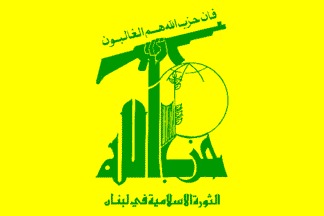
The next topic on the agenda was the armed wing of Hezbollah (Party of God). The leader of the Party, Sheikh Hassan Nasrallah presented a lengthy report over seventy minutes during which he outlined the strategic necessity for Hezbollah to maintain its armed wing, in view of Israeli aggressive territorial ambitions. He stressed the fact that if the Lebanese Army were to be deployed on the Lebanese-Israeli frontier, one sweep of Israel jets would be sufficient to annihilate such deployment, whilst in the case of Hezbollah, its fighters are not recognizable. They melt in the environment as simple peasants and cannot be targeted, in addition to the fact that Hezbollah’s arsenal of long-range missiles was well hidden and cannot be reached by Israel.
The presentation was well and positively received by one and all of the Delegates to the Conference, including Walid Jumblatt, the Druze leader himself who went as far as to congratulate Sheik Hassan on his lucid and cartesian presentation of the issue.
Consequently, Hezbollah will retain its armed wing until such time as peace has been signed with Israel, not a likely event in the foreseeable future. U.N. Resolution 1559, like so many others before it will be consigned to the drawers, already full of resolutions relating to Israel which have never been fulfilled.
Wednesday, May 10, 2006
Lebanon - Country or Myth
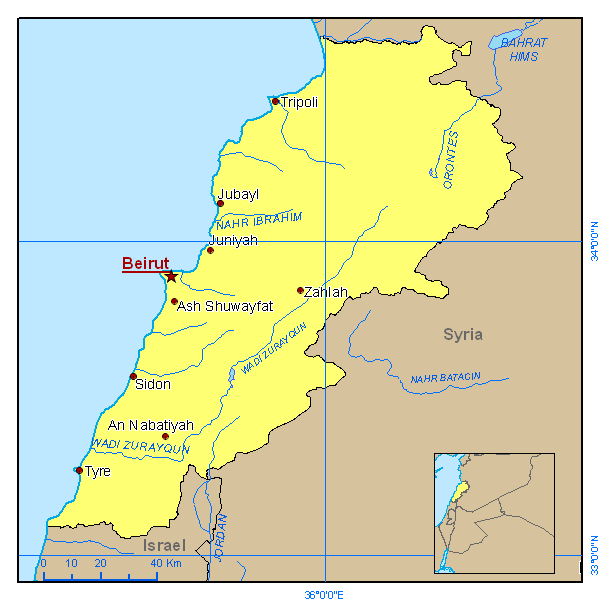
There is not a Lebanese citizen who does not complain regarding the performance, or rather the lack of performance, if not the very existence of the Lebanese Government on every level, social, political or economic. Lebanon is a country riven by confessional consideration, and is largely feudal in character. There is no such thing as national consciousness of loyalty. Stop any person in the street and ask him what he is. His answer, but for rare exceptions will be, I am Druze, or I am a Moslem, or I am Christian, but hardly ever, I am Lebanese. In point of fact, but for a short period under the famous Emir of the Maan dynasty, Fakhreddine II in 1585, Lebanon never existed as a country within the context of its current frontiers. Under Fakhreddin II, Lebanon achieved almost total autonomy from the Ottoman Empire. With the Chehab Emirs who were Moslem by faith and not Druze, some of whom became Christian Maronites at a later stage, Lebanon shrank in dimension. North Lebanon, encompassing the whole of the Tripoli area, and South Lebanon, the stronghold of the Moslem Shiite community, formed part of the province of Syria. This remained as the geo-political situation until 1918, when following the Allied victory in World War I, and in conformity with the Sykes-Picot Agreement of 1917 which purported to divide the countries of the Fertile Crescent into British and French zones of influence, Lebanon and Syria wee handed to France under a League of Nations Mandate, while Iraq and Palestine and Transjordan went to Britain.
The first French High Commissioner in Lebanon proposed a small Lebanon, based on the historic collaboration between the Druze and and Maronite communities which had existed since Fakhreddine II, namely the territory extending from the river, Nahr-el-Bared in the North to the Litani river in the South with Mt. Lebanon in the centre and including a small portion of the Bekaa Valley i.e. Zahle and environs. North and South Lebanon were to remain as part of Syria. The plan was met with strong opposition from the Maronite Church, on the ground that the Church possessed large estate in South Lebanon. The plan was altered to include North and South Lebanon in Lebanon of today, thereby sowing the seeds of future dissension.
Lebanon which had flourished under the Maan and Chehab regimes became prey to ethnic and religious dissensions. The majority of the Moslems looked towards Syria and not Lebanon as their natural homeland, which gave rise to serious troubles in 1958 and to civil war as of 1975. Syria, on the other hand, never recognised Lebanon as an independent country within its current frontiers and has since 1920 fomented trouble to recover its lost territory which General Gouraud had generously awarded to Lebanon,
The current political situation in both Syria and Lebanon reflects this continuing tug of war. The end result of this situation is that Lebanese national feeling are paper thin. They tend to explode whenever Lebanon is subjected to foreign pressure.
The 14th March 2005 rally, following the assassination of Prime Minister Hariri, gave rise to hope that Lebanese consciousness had risen from the ashes. We fear not. The same dissentions that were evident before 14th March, have returned to frustrate the birth of a new coherent Lebanon.
There can be no future for Lebanon until such time as the Lebanese become conscious of their identity as Lebanese and not members of a confession.
Friday, May 05, 2006
War but not peace
The United States has become an instrument of war, primarily if not exclusively for the benefit of Israel. In a recent press conference, the President categorically stated that Israel was the United States’ closest ally, and that it was the duty of the United States to defend Israel, hence the war on Iraq, which if allied with Syria would have constituted a potential threat to Israel. It was not the myth of the so-called weapons of mass destruction, which President Bush invoked as a reason of waging war on Iraq. Such weapons never existed and the United States was well aware of it. The war on Iraq was planned by the Zionist lobby in Washington which included such characters as Pearle, Wolfowitz and Dick Cheyney as early as 1998. As a potential threat to Israel, Iraq had to be eliminated. The United States is doing a good job in eliminating Iraq from the face of the earth. One hundred Iraqis were killed on 3rd May to add to the many tens of thousands that have perished. That some 2,500 young Americans have lost their lives for the sake of Israel does not seem to bother President Bush.
The atomic threat which President Bush invokes in the case of Iran is as fictitious as the weapons of mass destruction in Iraq. It will be many years before Iran can produce an atomic bomb. Even then, it will not have the means to deploy such a weapon against the United States. On the other hand, Iranian missiles can reach Tel Aviv, which explains the campaign which President Bush has orchestrated against Iran and its Syrian ally.
So it all boils down to the Israeli tail wagging the American head, and we in the Middle East are paying the price to a point where the tragic Palestinian problem has been forgotten, or relegated to a non issue.
The irony lies in the fact that having insisted on Palestinian democratic elections, the United States which had monitored the elections, now refuses to recognize the results of those elections because the overwhelming winner, Hamas, does not regard Israel with friendly eyes. The United States has in fact imposed sanctions on a freely elected Government by cutting off essential funding, essential for the very lives of the Palestinian people, but who cares so long as they are not Jewish.
Added on 5th July 2006
Having destroyed by air, land and sea all essential services in the Gaza strip such as electricity, water, roads and bridges, and having imposed a total blockade of the whole area with the object of destroying an entire people through hunger, Israel has mobilized the media of the whole world for the sake of one soldier captured in battle, while hundreds if not thousands of Palestinian prisoners languish or die in Israeli jails.
End of addendum
If only Lord Balfour were to rise from the dead, he would be appalled by the misery which has been inflicted on the Palestinians as a result of his famous 1917 Declaration. Over the centuries, Palestine has been conquered and occupied by more nations that can be counted. In terms of history, Israel will also perish like so many other conquerors.
The atomic threat which President Bush invokes in the case of Iran is as fictitious as the weapons of mass destruction in Iraq. It will be many years before Iran can produce an atomic bomb. Even then, it will not have the means to deploy such a weapon against the United States. On the other hand, Iranian missiles can reach Tel Aviv, which explains the campaign which President Bush has orchestrated against Iran and its Syrian ally.
So it all boils down to the Israeli tail wagging the American head, and we in the Middle East are paying the price to a point where the tragic Palestinian problem has been forgotten, or relegated to a non issue.
The irony lies in the fact that having insisted on Palestinian democratic elections, the United States which had monitored the elections, now refuses to recognize the results of those elections because the overwhelming winner, Hamas, does not regard Israel with friendly eyes. The United States has in fact imposed sanctions on a freely elected Government by cutting off essential funding, essential for the very lives of the Palestinian people, but who cares so long as they are not Jewish.
Added on 5th July 2006
Having destroyed by air, land and sea all essential services in the Gaza strip such as electricity, water, roads and bridges, and having imposed a total blockade of the whole area with the object of destroying an entire people through hunger, Israel has mobilized the media of the whole world for the sake of one soldier captured in battle, while hundreds if not thousands of Palestinian prisoners languish or die in Israeli jails.
End of addendum
If only Lord Balfour were to rise from the dead, he would be appalled by the misery which has been inflicted on the Palestinians as a result of his famous 1917 Declaration. Over the centuries, Palestine has been conquered and occupied by more nations that can be counted. In terms of history, Israel will also perish like so many other conquerors.
Friday, April 28, 2006
Pandemonium
The political scene in Lebanon defies all analyses in its complexity and utter futility. We have a President of the Republic who sits but does not govern except negatively in frustrating the efforts of the Prime Minister to manage the affairs of the State. We have a Prime Minister who bravely tries to govern but who finds himself blocked at every turn by machinations carried out through a Syrian second column such as Deputy Naser Qandil who had just emerged on the political scene after eclipsing himself for some twelve months for having been suspected in having a hand in the assassination of Prime Minister Rafic Hariri. We have a Speaker of the House of Parliament, serving a fourth term as Speaker, a wheeling dealing Machiavellic figure who has exploited his astute qualities to advance his own career, both financially and politically and who continues to dominate the Parliamentary scene. We have Saad Hariri who wears the political mantle of his assassinated father, with a Parliamentary bloc of some seventy Deputies. The pot pourri of Lebanese politics includes, of course Walid Jumblatt, the acknowledged leader of the Druze community, and on the other side of the fence, we have a General Aoun, an “officier médiocre” according to his official military career who has the temerity to declare himself as the future President of Lebanon. What fools these mortals be. To achieve this objective, he the Maronite par excellence, has allied himself with Hezbollah, described by some as a militia and by others as a resistance movement, which was largely responsible in driving Israel out of Lebanon. On the scene also is Samir Geagea, who following twelve years of imprisonment now speaks as a responsible statesman. There are others whom we may have forgotten.
All the above characters, as of this evening, Friday 28th April, will meet to resume the General Dialogue Conference, adjourned from its last session a month ago, to consider unresolved issues of national importance, such as the Presidency, and how best to get rid of President Lahoud, to our mind a dead issue, for he will remain till the end of his Syrian dictated mandate. A second important issue, if not the most important, relates to Syrian Lebanese relations which are very strained at this very moment, and last but not least, a hitherto forgotten hamlet in South Lebanon under Israeli occupation. The question is whether this hamlet, known as Shibaa Farms is Syrian or Lebanese. As part of Lebanon it provides Hezbollah with an alibi to maintain its military wing, but if Syrian, then Lebanon has nothing to do with it. Syrian has declared verbally that it is Lebanese, but it has refused to sign an official document to that effect.
It is our opinion that the Conference to which we referred earlier on will lead nowhere. It has been and will remain a dialogue between deaf people.
For the rest, God, in His infinite mercy, may decide to save Lebanon from destruction.
All the above characters, as of this evening, Friday 28th April, will meet to resume the General Dialogue Conference, adjourned from its last session a month ago, to consider unresolved issues of national importance, such as the Presidency, and how best to get rid of President Lahoud, to our mind a dead issue, for he will remain till the end of his Syrian dictated mandate. A second important issue, if not the most important, relates to Syrian Lebanese relations which are very strained at this very moment, and last but not least, a hitherto forgotten hamlet in South Lebanon under Israeli occupation. The question is whether this hamlet, known as Shibaa Farms is Syrian or Lebanese. As part of Lebanon it provides Hezbollah with an alibi to maintain its military wing, but if Syrian, then Lebanon has nothing to do with it. Syrian has declared verbally that it is Lebanese, but it has refused to sign an official document to that effect.
It is our opinion that the Conference to which we referred earlier on will lead nowhere. It has been and will remain a dialogue between deaf people.
For the rest, God, in His infinite mercy, may decide to save Lebanon from destruction.
Wednesday, April 26, 2006
Terrorism
More often than not, terrorism is a by-product of repression and oppression. Such was the case of the Palestinian suicide bomber who blew himself up in the midst of Tel Aviv, killing nine Jews and wounding many others, to escape the indignity of hunger and starvation which threatens the whole of the Gaza district as a result of the Israeli land and sea blockade of the area. That twenty year old Palestinian has been branded as a terrorist. Israel with its wanton destruction, confiscation and mass murder or imprisonment has escaped that condemnation, because in President Bush's twisted mind, Israeli terrorism is justifiable. The same President Bush had made a point of calling for free and democratic Palestinian elections and went as far as to send observers to monitor the elections. Hamas, known enmity to Israel, won with an overwhelming majority, which led the same President Bush to bulldoze economic sanctions to throttle the new Hamas Government. If that is not mass terrorism, how else can we describe it; a blatant attempt to starve a whole nation.
The line between rebellion, revolution and terrorism is very thin. To the oppressed, terrorism can be the only means available to avoid oppression, even though the end result can be counter productive.
The Al Dahab Sinai terrorist attack, or rather holocaust is a heinous terrorist attack, where unlike the Palestinian who blew his life away, the perpetrators have so far escaped justice and retribution. A pin prick against the Egyptian economy in discouraging tourism, cannot by any standard justify the assassination of foreign visitors enjoying a holiday on Egyptian soil.
Let it be said once and for all, terrorism, be it state sponsored or perpetrated by individuals cannot be tolerated nor condoned by any moral standard or ethic, regardless of the objective. It is the gravest of sins, for in the words of God, "though shalt not kill your brother.
The line between rebellion, revolution and terrorism is very thin. To the oppressed, terrorism can be the only means available to avoid oppression, even though the end result can be counter productive.
The Al Dahab Sinai terrorist attack, or rather holocaust is a heinous terrorist attack, where unlike the Palestinian who blew his life away, the perpetrators have so far escaped justice and retribution. A pin prick against the Egyptian economy in discouraging tourism, cannot by any standard justify the assassination of foreign visitors enjoying a holiday on Egyptian soil.
Let it be said once and for all, terrorism, be it state sponsored or perpetrated by individuals cannot be tolerated nor condoned by any moral standard or ethic, regardless of the objective. It is the gravest of sins, for in the words of God, "though shalt not kill your brother.
Tuesday, April 25, 2006
The cast
 Emile Lahoud
 Fouad Siniora
 Nabih Berri
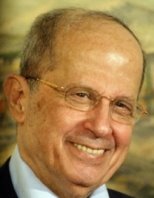 Michel Aoun
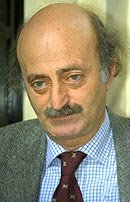 Walid Jumblatt
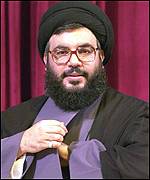 Sheikh Hassan Nasrallah
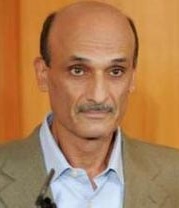 Samir Geagea
Monday, April 24, 2006
Introduction : The Wizard of Beirut has just been conceived

The Wizard of Beirut has just been conceived as a project to analyse and comment on developments in the Middle East and more specifically in Lebanon. For Lebanon we will begin with a cast of the characters concerned, "Dramatis personae", for the most part megalomaniac self centred politicians whose primary concern has been to serve their own interests rather than the interests of Lebanon.
At the top of the pinnacle stands or rather sits President Emile Lahoud who clings to his presidential seat with demonic ferocity, despite the rising tide of unpopularity and opposition to his very existence. Nominated to his high office of President of the Republic by the Syrians who occupied Lebanon at that time and who bulldozed a prolongation of his six year term of office by an additional three years, using threats against Prime Minister Rafik Al Hariri and a number of Lebanese deputies to insure a favourable parliamentary vote.
The next character of the cast is the Speaker of the House. Nabih Berri, who is currently serving his fourth four year term of office as Speaker. He is machiavellic and very astute, and very au courant with the foibles and seamy side of his deputies which he has exploited to perfection to perpetuate his position as Speaker of the House.
Prime Minister, Fouad Siniora, is more of a sheep among the wolves. Nonetheless, he has shown great courage and innate political sense in facing and dealing with the challenges of his critics in and out of Parliament, and of course in dealing with the ever looming menace of the Syrian regime.
Out of office, we have a buffoon called General Aoun, who acts and speaks like a buffoon and who aspires to become President of Lebanon, with the help and support of the Hezbollah, a Shiite political and military group which takes credit for the liberation of South Lebanon from Israeli occupation. At the head of this group stands Sheikh Hassan Nasrallah, a charismatic cleric who runs Hezbollah (party of God) with an iron hand. He is a brilliant speaker and tactician and he is of course a close ally of Iran and Syria, on which two countries he relies for funds and arms.
Last by not least comes the feudal lord and socialist leader Walid Jumblatt who controls the Chouf mountains, the stronghold of the Druze community in Lebanon. He has and continues to play a principal role on the Lebanese stage. A skilled politician, he has an acute nose for the direction of the wind and he plays his respective roles accordingly. Currently he is very much anti-Syrian.
There are of course other actors on the stage, such as Samir Geagea of the Forces Libanaises, Samir Franjieh and others. They are important figures but they play a secondary role.
This introduction may help the readers to understand future developments in Lebanon.
Subscribe to:
Posts (Atom)